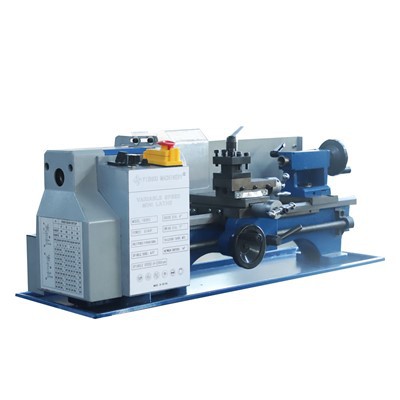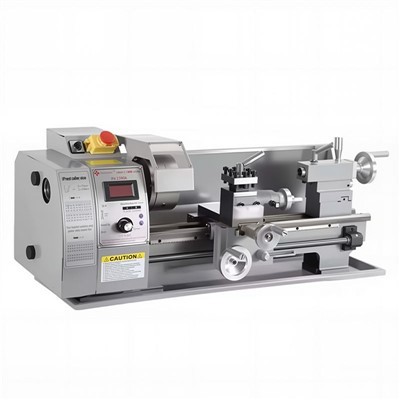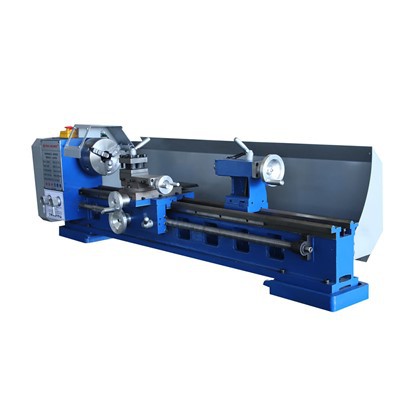
A woodworking lathe mainly consists of a bed, a tailstock mounted at the end of the bed guideways, a tool post mounted in the middle of the guideways, a headstock mounted at the head of the bed, a spindle mounted on the headstock and its chuck, a motor, and a speed transmission device.
Its transmission mechanism typically includes the following key components: a fixed half-pulley of the driven transmission pulley fixed to the end of the main shaft; a movable half-pulley fitted onto the main shaft and engaging with the fixed half-pulley; a push-pull arm mounted with bearings at the end of the movable half-pulley; a compression spring mounted between the push-pull arm and the headstock; a rack fixed to the push-pull arm, parallel to the main shaft and sliding within a hole in the headstock; a gear shaft with its meshing end passing through the headstock; an eccentric wheel with a handle mounted on a small shaft in an open slot at the end of the gear shaft; the movable and fixed half-pulleys of the driving transmission pulley mounted on the motor shaft or its connecting shaft; a compression spring mounted between the movable half-pulley and a retaining ring at the end of the motor shaft or its connecting shaft; and V-belts mounted on the driving and driven transmission pulleys.
Modern CNC woodworking lathes, especially dual-axis models, have undergone structural optimization to improve stability and precision. For example, they utilize a fully cast, one-piece, widened, and heavy-duty bed, which is tempered or aged to ensure structural stability and prevent deformation. The drive shafts are thickened to enhance machining stability. They are equipped with imported guideways and slides, and feature a bottom-locking design to effectively prevent wood dust from entering and affecting precision.