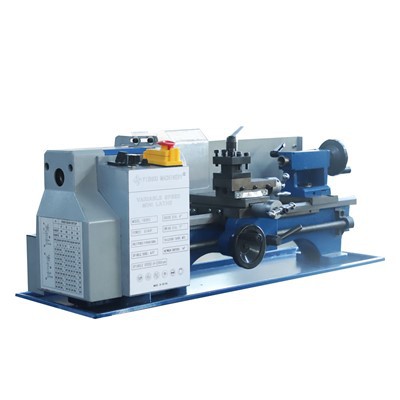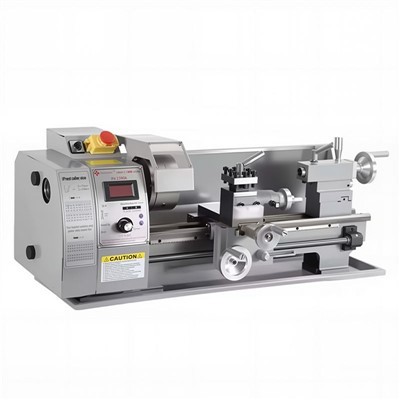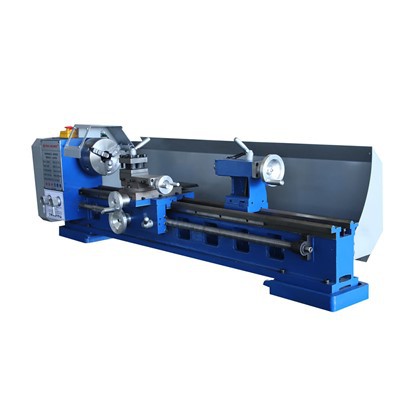
Ordinary Lathes: Suitable for machining a wide range of objects, with a large adjustment range for spindle speed and feed rate. Capable of machining internal and external surfaces, end faces, and internal and external threads. These lathes are primarily operated manually, resulting in low production efficiency. Suitable for single-piece, small-batch production and repair shops.
Turret and Rotary Lathes: Equipped with a turret or rotary tool post that can hold multiple tools, allowing the operator to complete multiple operations sequentially using different tools in a single workpiece setup. Suitable for batch production.
Automatic Lathes: Automatically perform multi-operation machining of small to medium-sized workpieces according to a set program. Automatic loading and unloading, and repeated machining of batches of identical workpieces. Suitable for large-scale, mass production.
Multi-Tool Semi-Automatic Lathes: Available in single-spindle, multi-spindle, horizontal, and vertical configurations. The single-spindle horizontal lathe has a layout similar to an ordinary lathe, but with two sets of tool posts mounted at the front and rear or above and below the spindle. Used for machining discs, rings, and shafts, its productivity is 3-5 times higher than that of an ordinary lathe.
Copying Lathes: These lathes automatically complete the machining cycle of a workpiece by copying the shape and dimensions of a template or sample (see copying machine tool). They are suitable for small-batch and mass production of workpieces with complex shapes, offering 10-15 times higher productivity than ordinary lathes. Types include multi-tool lathes, multi-axis lathes, chuck lathes, and vertical lathes.
Vertical Lathes: The spindle is perpendicular to the horizontal plane. The workpiece is clamped on a horizontal rotary table, and the tool post moves on a beam or column. Suitable for machining larger, heavier workpieces that are difficult to mount on ordinary lathes. They are divided into single-column and double-column types.
Gear Shaping Lathes: While turning, the tool post periodically reciprocates radially, used for shaping the tooth surfaces of milling cutters, hobs, etc. They usually have a grinding attachment, with a small grinding wheel driven by a separate motor to grind the tooth surfaces.
Specialized Lathes: Lathes designed to machine specific surfaces of certain types of workpieces, such as crankshaft lathes, camshaft lathes, wheel lathes, axle lathes, roll lathes, and ingot lathes.
Combined Lathe: Primarily used for turning, but with the addition of special parts and accessories, it can also perform boring, milling, drilling, planing, and grinding, possessing the characteristic of "one machine, multiple functions." Suitable for repair work on engineering vehicles, ships, or mobile repair stations.
Saddle Lathe: The left end of the bed of the saddle lathe is recessed at the headstock, allowing it to accommodate large-diameter parts. The lathe's shape, high at both ends and low in the middle, resembles a saddle, hence the name. Saddle lathes are suitable for machining parts with large radial dimensions and small axial dimensions. They are suitable for turning workpiece outer diameters, inner holes, end faces, grooving, and metric, imperial, module, and pitch threads. They can also perform drilling, boring, and reaming processes, making them particularly suitable for single-piece and batch production enterprises. Saddle lathes can machine large-diameter workpieces within the saddle groove. The machine tool guideways are hardened and precision ground, ensuring convenient and reliable operation. The lathe features high power, high speed, high rigidity, high precision, and low noise.